



Does a Cultivar Tell You How Matcha Will Taste?
A cultivar names the tea plant variety. Read it alongside origin and processing, without treating its name as a flavor guarantee.
By Roseline Zhou, Founder
Contents
Two packages carry different cultivar names. Should you expect two specific flavors? A cultivar is a selected tea plant variety from which the leaves come; its name alone doesn't describe the cup. The place, cultivation, processing, and any blending matter too.
We read those details together before judging the tea. Even a rare variety name doesn't guarantee a profile. After cultivation, the leaves go through the steps of making matcha; a label tells only part of their story.
Cultivar, terroir, blend: what does each word mean?
A cultivar names the tea plant variety. Terroir locates the conditions of the growing place. Blending brings different materials together to build a cup. "Single origin" may mean a region, a garden, or a batch: ask what scale is actually being claimed.
We'd ask that before equating single origin with a single cultivar. A powder can come from a stated place without coming from just one variety. A label is more useful when its terms are precise.
What do we know about Ujihikari, Gokou, and Tsuyuhikari?
Their existence can be verified, but a cultivar name doesn't give the taste of a particular matcha. For that, you'd need the batch listing and a tasting.
| Cultivar | What the source confirms | What it doesn't prove |
|---|---|---|
| Ujihikari | Listed by the Kyoto tea chamber among varieties used for tencha, the leaf milled into matcha | The taste of a matcha made with this variety |
| Gokou | Listed by the same source among varieties used for gyokuro, shade-grown green tea brewed from leaves | Its use in a particular matcha |
| Tsuyuhikari | Registered as a tea variety and described for sencha, Japanese green tea brewed from leaves | Its use in a particular matcha |
Uji tea cultivar classifications distinguish Ujihikari and Gokou; the Shizuoka Prefecture report describes Tsuyuhikari for sencha. These documents do not rank three matcha flavor profiles.
We'd leave the taste open rather than invent floral or vegetal notes. A variety can give different cups depending on how it's grown. Tasting remains the way to compare them.
Single origin or a blend: which should you choose?
A stated origin helps track provenance. A blend may aim for a chosen profile or a consistent expression. Neither name alone ensures the powder will suit your use.
To judge its texture and balance, we'd first taste this powder with water without forgetting traceability. A region such as Shizuoka or Kagoshima indicates a stated place, not automatically the leaf's cultivar.
How do you read a matcha product listing?
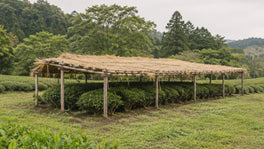
Look separately for the region, variety, harvest year, and processing. Shading the tea plants describes a growing condition distinct from the cultivar.
Keep the cultivar's exact spelling when comparing two listings. A similar name may mean a different variety. To check names without inferring flavor:
- Kyoto lists the Asahi cultivar among varieties used for tencha.
- The Okumidori variety is a late-harvest cultivar, not a region.
- Born from a cross of Yabukita and Asatsuyu, the Saemidori cultivar still doesn't tell you where the leaves grew.
- Don't confuse the Samidori variety with Saemidori: the former comes from local Uji tea plants, the latter from a cross.
- Depending on how its leaves are processed, the Yabukita cultivar may be used for a tea to steep or as material for matcha.